Construction BIM models in cost planning
The use of BIM modelling is gradually becoming an industry expectation, although only few companies possess truly high-level expertise. What is even less evident is how BIM influences and rationalizes costs — despite the fact that its impact is substantial.
In Hungary, BIM modelling is no longer new, although the number of companies with real competence is still limited. One of the first knowledge hubs in this field is CÉH zRt., where the BIM experts are led by Balázs Tudlik.
As increasingly detailed BIM models — capable of handling more and more layers — become accessible to every specialist, a growing part of engineering and design work shifts into the preparation phase. The BIM model and the cost-planning system work hand in hand: costs are managed by a dedicated database that is directly linked to the BIM software, so any modification in the model that alters material or labour needs appears almost automatically in the cost calculation. BIM solutions allow numerous building materials to be modelled with precise quantity take-offs; since their cost and labour requirements differ, the system supports the development of the optimal solution through comparison. This means that the appearance, effects and suitability of each variant can be simulated within the same virtual space — while the financial consequences are visible instantly.
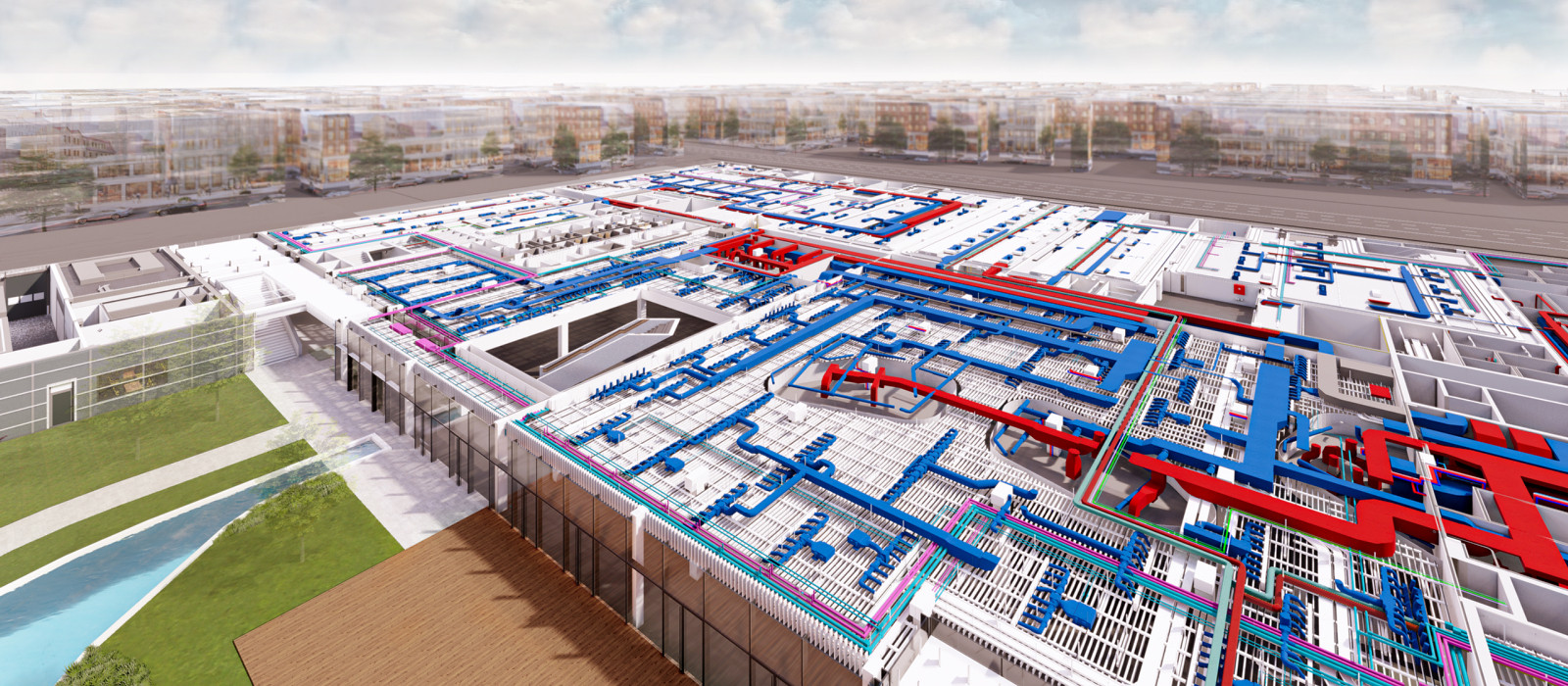
Collision-free design is another major advantage with significant cost implications. A collision occurs when two building elements intersect unrealistically in the model — for example, an MEP duct “running into” a structural element. Since the model can be refined to zero clashes, construction can begin with the assurance that, if everything goes according to plan, no such conflict should arise. While this does not eliminate execution-phase human error, it ensures that at least the plans themselves do not contradict each other. As a result, the need for designer supervision is reduced, and both project management and technical supervision become more efficient.
A detailed BIM model is also useful on-site. A site engineer can open the model on a tablet and, using augmented reality technology, project it onto the live camera view. This way, differences become visually obvious, and the specialist can decide whether the deviation requires correction or has any relevance at all. This method is not only faster than manual measurements but also more attentive — no discrepancy is lost due to fatigue or time pressure.
The financial benefits of BIM do not end with ribbon-cutting. If the model is created with this purpose in mind, or updated accordingly, it can be integrated into the facility-management system. Not only can all equipment be located instantly, but operating times, maintenance cycles and warranty information can also be incorporated — even automating maintenance work orders. This frees up significant resources (and therefore cost) in facility management, especially in complex building systems.
Among CÉH zRt.’s references, several buildings — such as the BMW plant in Hungary or the Bosch Campus — required this management capability from the outset, as do inherently complex facilities like hospitals, theatres or certain public buildings.
It is important to note, however, that when creating a BIM model, future use cases must be clearly understood. The required level of detail, the included systems and the exclusions all matter. Although adjustments can be made later, they are always more expensive — just as in construction. This is one of many reasons why involving an experienced project manager from the very beginning is worthwhile: they can help identify the ideal solution early on.
The article was published on the online platform of VG on 8 December 2025.