Bridge Design & Engineering
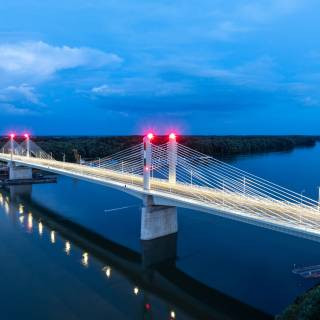
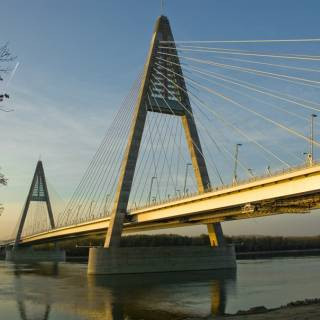

Plans for new bridges or bridge renewal construction works and as-built drawings of structures are made at the level of study, authorization or construction plan according to customer requirements by our engineers having outstanding professional experience and knowledge. Planning the structures is supported by state-of-the-art software tools.
Providing feasibility study
The compilation of feasibility studies to be undertaken in connection with road, railway, walkway and bicycle network development will be carried out in cooperation with our partners who design linear facilities. Several route versions will be drawn up, assessing the bridge and structure requirements of each version. In case of crossing rivers or major valleys, a feasibility study for several bridge versions is made using various structural constructions and materials.
Concept Design
Shape and appearance of the planned facilities is developed in cooperation with experienced architects. The structures planned in the study phase are adapted to the existing environment (planned or natural) and developed so as to match it. To demonstrate this, 3-dimensional models are made. Through animations and visualizations, a more substantial information is given to decision makers.
Design of construction technologies
It is always required to use special technologies for the construction of individual, wide span bridges or the ones built at a great height. In general, the technology to be used is retroactive to structural design, being in continuous interaction with it.
Depending on the specific design phase, generic technology design is carried out or in case a particular customer requirement, the construction technology fit to the available asset and equipment fleet, as well as the temporary support structures.
Tender preparation and cost estimate
In the competitive tendering period, support is given according to the contractor requirements. Subject to an agreement, the tender design drawn up may contain plans of authorization to construction level, Bills of Quantities and quantity calculations, technical specifications, as well as cost estimates relying on up-to-date database giving help to evaluate the proposals for works.
Design supervision
Subsequent change requirements coming to light during construction, as well as structures made otherwise than planned are given priority during the Design supervision. Requirement for the architect to supervise and check the implementation according to the plan of the structure under construction arises mainly in case of exceptional specific design solutions.
Technical supervision
In the course of the implementation process, technical supervisors represent the clients’ interests as well as check the proficiency of construction, as well as the observance of relevant legislation, authority regulations, standards, contracts and those set out in the construction documents.
Expertise and consultancy
Expert’s or consultant’s duties following constructional defects, natural disasters, damages to structure and other cases of force majeure are given priority.
Design verification
Taking into account the law requirements, verification of the design documents in various design phases and independent structural calculations both in cases specified by the Authority and of customer requirement is carried out by our highly skilled engineers having an outstanding professional experience.
Testing of bridge condition and inspection of bridge structure
The inspection of bridges (main test, target test and other tests) is made through the engagement of partners such as geodesist, geotechnician and material inspector, if required. Based on the test results, a proposal for actions and interventions to be done is worked out.
Design of roads and urban transport
As one of the lead companies on the engineering services market, CÉH Inc. is to promote a complex approach to planning responsibilities and from this perspective, it assumes responsibility of generic nature in coordination of planning large projects.
Beyond civil engineering and bridge planning responsibilities to which priority is given by CÉH Inc., transport planning usually forms an integral part of planning responsibilities in civil engineering and town planning. For large projects, where transport planning responsibilities arise in the wider perspective of network development, specialist companies focusing on this domain or highly skilled experts are engaged in planning.
Frequently Asked Questions and Answers
How is a bridge inspection carried out with CÉH’s expert team, and what does the inspection report include?
During a bridge inspection, our bridge experts first review the available design documents and records, then conduct an on-site inspection. We thoroughly examine the condition of the structural elements and bridge appurtenances, identifying defects and deterioration. Where required, we perform instrument-based diagnostic testing, including both destructive and non-destructive examinations, and, if necessary, load testing.
Based on the findings and measurement results, we prepare a detailed inspection report that includes a condition assessment, load-bearing capacity evaluation, recommended interventions, priorities, and a scheduling proposal. For the Operator, this report provides the basis for making decisions on the further measures required.
Source: CÉH zRt. bridge inspection team, last updated: March 2026.
Why is it important to regularly inspect road and railway bridges, and what types of inspections exist?
The condition of bridges directly affects traffic safety and operating costs. Without regular inspections, hidden damage may only be detected late, potentially leading to traffic restrictions, forced closures, and costly urgent interventions.
Bridge inspections performed by CÉH are typically a combination of expert on-site assessments, detailed instrument-based diagnostic testing, load-bearing capacity evaluations, and—when necessary—load testing, complemented by digital point-cloud surveying on request. Based on the results, the Operator can prioritize interventions.
Source: CÉH zRt. bridge inspection team, last updated: March 2026.
What load-bearing capacity and condition assessments are required for an existing bridge, and how often?
During the operation of an existing bridge, regular inspections are required (e.g., on an annual basis and every 10 years). Depending on the findings, load-bearing capacity assessments and—in certain cases—specialized instrument-based measurements may also be necessary.
Inspection frequency depends on the bridge type, age, traffic, environmental exposure, previous inspection results, observed defects, and the need to investigate them. Legislation requires bridge inspections annually and every 10 years; however, bridges in critical condition may be subject to an individually defined frequency. CÉH reports include specific intervention recommendations and priorities, supporting the Operator’s responsible decision-making.
Source: CÉH zRt. bridge inspection team, last updated: March 2026.
What are the design stages of creating a new bridge, and which is the most critical?
Designing a new bridge begins with preparatory studies (site, alignment, selection of structural type), followed by concept design, permitting design, tender design, and construction design phases.
The most critical points are the early decisions, when the structural type, span arrangement, pier locations, and the related construction technology options are determined. Choosing the optimal structural concept is crucial for the later design phases and for long-term operation. In this phase, CÉH’s bridge design office establishes the foundations that determine the bridge’s economical maintainability and operational safety for decades.
Source: CÉH zRt. bridge design team, last updated: March 2026.
How do load requirements and site conditions influence the structural design of a bridge?
A bridge’s structural system is determined by the required functions, traffic loads (road, rail, pedestrian, bicycle), span lengths, soil and foundation conditions, the obstacle to be crossed (river, valley, road), and environmental effects (wind, temperature, corrosion, and potentially seismic conditions).
Radically different solutions may be appropriate for a heavily loaded railway bridge compared to a pedestrian bridge integrated into an urban skyline. CÉH bridge experts evaluate multiple structural alternatives in each case, carrying out a detailed assessment from load-bearing capacity, construction technology, operation/maintenance, and cost perspectives.
Source: CÉH zRt. bridge design team, last updated: March 2026.
What determines whether a bridge is built from steel, reinforced concrete, or a composite structure?
Material selection is determined by span length, loading, construction technology, environmental exposure, maintenance requirements, and investment/life-cycle cost—and not least by the locally available materials.
For long spans, steel or steel–reinforced concrete composite structures are often the most economical solution, while for shorter spans, reinforced concrete can be highly competitive. CÉH bridge experts examine different structural alternatives and provide the Client with a recommendation that ensures technical safety and long-term cost efficiency.
Source: CÉH zRt. bridge design team, last updated: March 2026.
What special tests and simulations precede the permitting of a road or railway bridge?
For road and railway bridges, structural design is supplemented by dynamic, fatigue, and stability checks, and, where required, by wind, seismic, and other analyses. For railway bridges, dynamic and fatigue assessments and track–bridge interaction are particularly important; for road bridges, traffic loading and fatigue life are key considerations.
CÉH uses advanced computer models and finite element simulations that address different load cases, combinations, and extreme scenarios.
Source: CÉH zRt. bridge design team, last updated: March 2026.
When is it justified to renovate an existing bridge, and how is the need identified?
Renovation is justified when bridge inspection findings reveal damage, in extreme cases reduced load-bearing capacity, or functional deficiencies, or when traffic requirements change (higher loads, a new connection is created). Indicators may include increasing maintenance needs, the introduction of restrictions, or new load standards.
CÉH expert opinions provide a detailed condition assessment and load-bearing calculations, and specify whether minor localized repairs are sufficient or whether a comprehensive renovation or even reconstruction is required.
Source: CÉH zRt. bridge inspection and bridge design team, last updated: March 2026.
What methods does CÉH use for the digital survey of existing buildings (and bridges)?
For bridges, CÉH uses laser scanning and drone surveys. Laser scanners capture a dense 3D point cloud of the structure, while drones document the superstructure, hard-to-reach areas, and the surroundings. From the point cloud, a geometric model or a BIM model can be created, providing a reliable basis for load-bearing capacity evaluations, renovation designs, and the development of connection details. This reduces survey errors and lowers the risk of surprises on site.
Source: CÉH zRt. digital surveying and bridge design team, last updated: March 2026.
How does digital surveying (laser scanning, drones) support bridge design and renovation?
The result of laser scanning and drone surveying is a dimensionally accurate point cloud— a digital “twin” of the bridge. Based on this model, CÉH bridge experts carry out condition assessments, load-bearing capacity evaluations, and renovation design. Deformations, deflections, damage, and structural deviations become clearly visible. This leads to more accurate intervention plans, more reliable cost estimates, and fewer surprises during construction.
Source: CÉH zRt. bridge inspection and bridge design team, last updated: March 2026.
For which types of projects are drone and laser-scanner surveys recommended?
For bridges, drone and laser-scanner surveys are particularly justified for long-span structures, bridges that are difficult to access, heavily trafficked bridges, and structures of historic/heritage value. The method is fast and safe, can reduce or replace the need for scaffolding in many cases, and reveals details that are difficult to capture with conventional approaches.
Source: CÉH zRt. digital surveying and bridge design team, last updated: March 2026.