Building Design and Engineering
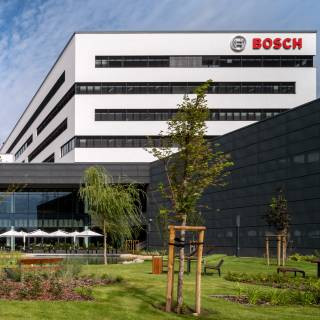
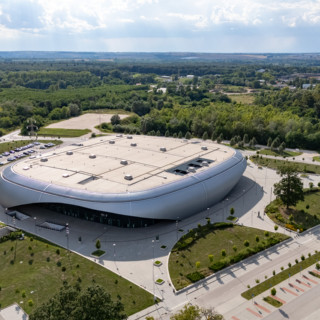
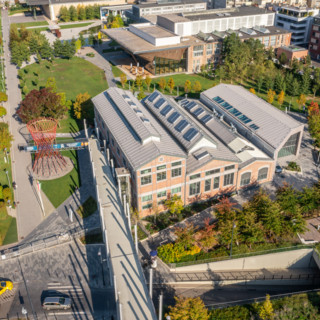
Building Design is one of the comprehensive engineering services offered by CÉH. It is offered as a stand-alone Building Design service, as well as in conjunction with our Project Management and Bridge Design services.
Our Building Design division includes the following activities
- Design and planning for international clients;
- Design for international projects in Hungary and in an international standard environment;
- Design and planning in cooperation with international partners;
- Design and planning according to the guidelines of the Hungarian Chamber of Architects and the Hungarian Chamber of Engineers, as well as international guidelines (HOAI, BREEAM, LEED, etc.);
- Design and planning according to Hungarian, EU (MSZ, EN) and other foreign standards (DIN, ASA, Russian standards, etc.).
The design & engineering projects we mainly work on are
- Green field investments,
- Brown field investments, and
- Projects related to listed buildings.
Team
Over the past decades, our design department has gained extensive international experience and multi-generational know-how. Our 90-member multilingual team covers all design disciplines (architectural, electrical, HVAC, structural) and their work is managed by a project coordination team. To maintain a high level of quality, our teams work with state-of-the-art design solutions (BIM and GIS) and tools (e.g. 3D design, 3D laser scanning, drone filming).
Our building design department focuses on maximum representation of the client's interests and meeting the client's requirements.
Our Services
Our Building Design Department undertakes complete design assignments performed by our in-house (architectural, structural, HVAC, electrical) design teams. Each specialized engineering team works as a single unit or as separate services.
The success of our work is achieved through
- The Project Coordination Team,
- The multiple in-house architectural studios,
- The Structural Design Team
- The HVAC Design Team
- The electrical design team, and
- The BIM and GIS team.
Find the complete list of our specialized engineering and design services here.
Consultancy and Special Engineering Services
- Site analyses, Due Diligence Report (DDR)
- Development and optimisation of urban and building development concepts
- Technical feasibility studies
- Investment technical program, planning program
- Build-up studies
- Architectural consultancy
- Building structural consultancy
- Structural consultancy
- Building engineering consultancy
- Building electricity consultancy
- Energy consultancy
- Analysis and application of renewable energy sources
- Condition and status surveys
- Environmental impact studies, preliminary, detailed, IPPC
- Soil mechanical expert report
- Soil and groundwater contamination/pollution analysis
- Geodetic survey
- Acoustic consultancy
- Investment cost analysis
- Investment process schedules
- Operating system setup (PM preparation)
Frequently Asked Questions
What are the advantages of having general design carried out by a single design office?
When general design is handled by one team, you have a single responsible partner for the entire design process. As general designer, CÉH coordinates architectural, structural, mechanical, electrical, fire safety, utility and BIM design, while maintaining a consistent concept from start to finish. This means fewer clashes, faster coordination and clearer responsibilities. You do not have to mediate between separate disciplines; an integrated team works to ensure that the facility is delivered economically, remains easy to operate, and minimises additional works during construction.
Source: CÉH zRt. general design team, last updated: May 2026.
What are the advantages of having project management and general design within one organisation?
When project management and general design are handled by the same organisation, technical decisions do not have to be “translated” separately into business language and back again. At CÉH, the PM team and the designers shape the project together: at every decision point, we consider technical feasibility as well as time and cost impacts. This reduces misunderstandings, speeds up coordination, and can lead to fewer changes and disputes during design and construction. It also creates a clearer responsibility structure, with comprehensive representation of the client’s interests.
Source: CÉH zRt. general design and project management team, last updated: May 2026.
What exactly does complex general design service mean?
By complex general design, we mean that full design responsibility is held by one partner. At CÉH, depending on the project, this may cover everything from the architectural concept through structural, mechanical, electrical and utility design to road and bridge design, as well as BIM modelling. We select and coordinate the specialist designers, manage clashes between design packages, liaise with authorities, and communicate with the investor through a single channel. As a result, the client receives an integrated, transparent and well-organised design process, along with high-quality design documentation.
Source: CÉH zRt. general design team, last updated: May 2026.
Why is a permit design not enough, and what does a detailed construction design add?
The purpose of a permit design is to obtain authority approval: it presents the function, site layout, main dimensions and basic technical solutions. However, the contractor needs much more information than this. CÉH’s detailed construction design includes junction details, dimensioned structures, mechanical and electrical networks, schedules, quantity take-offs and the BIM model. It provides clear instructions on what needs to be built and how, reduces on-site improvisation, errors and additional works, and provides a reliable basis for accurate pricing.
Source: CÉH zRt. general design team, last updated: May 2026.
In what cases is it worth preparing a detailed construction design, and what are the risks of not having one?
A detailed construction design is recommended for almost every major investment, especially for projects with complex geometry, high technical risk or tight schedules. Without a construction design, many details must be decided by the contractor on site, which may lead to errors, additional works, cost and time overruns. In many cases, the preparation of construction designs before the start of construction is required by law. In CÉH projects supported by construction design and BIM models, the rules are clearer, with fewer disputes and less uncertainty.
Source: CÉH zRt. general design team, last updated: May 2026.
What exactly does a detailed construction design contain, and what role does it play in successful construction?
A detailed construction design is the complete “recipe” for implementation: detailed floor plans, sections, elevations, junction details, structural calculations, mechanical and electrical network designs, schedules, quantity take-offs, and their representation in a BIM model. In line with the investor’s expectations, these documents include the information needed from the concept stage onwards so that the contractor knows exactly what to build and how. This reduces on-site improvisation, errors, additional works and disputes, helping the project stay on schedule and within budget.
Source: CÉH zRt. general design team, last updated: May 2026.
Why is it important to involve a general design team before the permitting phase?
When CÉH’s general design team becomes involved before permitting, the architectural concept is shaped not only by aesthetics, but also by structural, mechanical, electrical and operational considerations. This means that the permit design is not merely a visual or architectural drawing, but a realistic, buildable concept that provides a stable basis for further design. It reduces the risk that, after permitting, it becomes clear that the design is uneconomical or difficult to construct and must be redesigned.
Source: CÉH zRt. general design team, last updated: May 2026.
How can consistency between the architectural concept and specialist designs be ensured?
The key to consistency is continuous communication and integrated model use. At CÉH, architects and specialist designers work in a shared BIM model, supported by regular coordination meetings. Already in the concept phase, we coordinate architectural ideas with mechanical, electrical, structural and fire safety requirements. Clash detection and the common data environment ensure that the final design is not only aesthetically sound, but also technically consistent and buildable.
Source: CÉH zRt. building design and BIM team, last updated: May 2026.
From a professional point of view, how does the design of an industrial, residential and heritage building differ?
For industrial buildings, the focus is on functionality, technological processes, logistics and operational efficiency. For residential buildings, the main priorities are liveability, comfort, energy performance and user experience. For heritage buildings, value protection, heritage preservation, special materials and structural solutions, as well as authority coordination, are dominant. CÉH has experience in all three areas, so we always incorporate the specific requirements and risks of the given building type into the design concept.
Source: CÉH zRt. building design team, last updated: May 2026.
How does coordination and decision-making between design phases work in a complex project?
A complex project is guided through clearly defined design phases: concept design, permit design, tender design and construction design. At the beginning of each phase, we jointly define the objectives, and at the end we hold a formal decision point. As general designer, CÉH collects specialist proposals, alternatives and their impact on time, cost and operation, then presents them to the investor in a clear summary. This allows decisions to be made in a structured manner rather than on an ad hoc basis.
Source: CÉH zRt. general design team, last updated: May 2026.
What methods does CÉH use for the digital surveying of existing buildings?
For existing buildings, we use laser scanning and, where necessary, drone surveying. Terrestrial laser scanners create millimetre-accurate point clouds of interior and exterior spaces, while drones capture the building’s exterior, hard-to-access parts and surroundings. A 3D model is then created from the point cloud, providing an accurate basis for refurbishment, conversion or extension designs. This significantly reduces the risks arising from old or inaccurate drawings.
Source: CÉH zRt. digital surveying and BIM team, last updated: May 2026.
How does digital building surveying, such as laser scanning and drones, support design and refurbishment?
The result of digital surveying is a realistic, dimensionally accurate 3D point cloud, essentially a digital twin of the building. CÉH’s designers base refurbishment or extension designs on this data, relying on real geometry rather than old drawings or estimates. Deformations, deviations, bottlenecks and hidden clashes become visible. This reduces surprises during construction and improves the accuracy of planning for demolition, strengthening works and costs.
Source: CÉH zRt. digital surveying and building design team, last updated: May 2026.
What digital tools and modelling methods are used in building design?
In our building projects, we use 3D/BIM-based modelling, laser scanner point cloud processing, energy and daylight simulations, finite element structural analysis and visualisation tools. Designs are available in a common data environment, allowing architects, structural, mechanical and electrical designers to work on the same model. The purpose of digital tools is not merely visual presentation, but to provide accurate data and easily understandable visual information for investor decisions.
Source: CÉH zRt. building design and BIM team, last updated: May 2026.
What digital tools and developments does CÉH use to support innovative engineering services?
We use model-based BIM platforms, 4D/5D simulations, laser scanners, drone surveying, common data environments (CDE), automated quantity take-offs, parametric design tools and visualisation solutions. These are complemented by our own reporting and dashboard systems, which present the project status to the investor in an easy-to-understand format.
Source: CÉH zRt. digital development and building design team, last updated: May 2026.
How can an engineering office help obtain green certifications, such as LEED or BREEAM, for industrial facilities?
An experienced engineering office ensures that green certification criteria are built into the project from the very beginning of design. CÉH’s sustainability experts work with the investor to select a realistically achievable certification level and align architectural, mechanical, energy and material-use decisions accordingly. The BIM model supports energy and performance calculations, documentation and data provision to certifiers. This means that green certification is not an afterthought, but a quality element embedded at concept level.
Source: CÉH zRt. sustainability and building design team, last updated: May 2026.
Why is parametric design useful for complex technical buildings?
In parametric design, the building is described through a system of rules and parameters, rather than as a static drawing. If an important parameter changes, such as span, module size or mechanical demand, the model reorganises automatically. CÉH uses this approach for complex industrial, infrastructure or special building projects where many interdependent conditions must be considered. This allows several options to be examined quickly, enabling the investor to choose from real alternatives while taking cost and schedule impacts into account.
Source: CÉH zRt. parametric and building design team, last updated: May 2026.
What problems can incomplete design documentation cause during construction?
With incomplete design documentation, the contractor is forced to make decisions on site, often under time pressure. If the investor’s intention is not communicated in sufficient detail when the construction contract is signed, this may lead to disputes, errors, contradictory solutions, additional works and cost increases after construction has started. Subsequent price negotiations may also become more frequent. A well-prepared, detailed, BIM-based construction design, by contrast, provides clear boundaries and reduces the risk of conflicts, additional works and delays.
Source: CÉH zRt. general design team, last updated: May 2026.