
Cost optimisation does not begin during construction
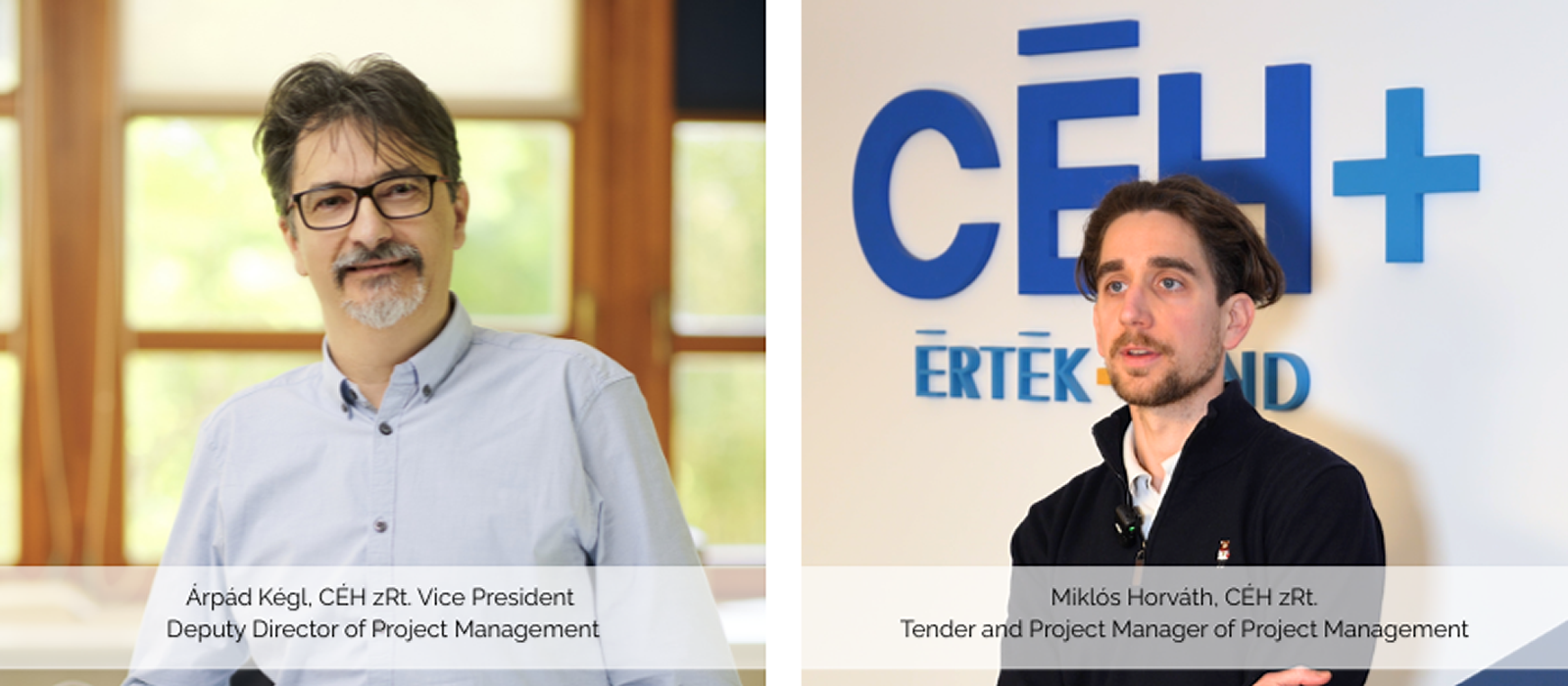
The success of investments is often determined by the very first decisions. We discussed this with the senior experts of CÉH zRt., a project management partner representing the investor’s side: Árpád Kégl and Miklós Horváth.
Costs in construction investments are still often treated as if they were primarily determined during the construction phase. In practice, however, the overall scale of a project’s final cost is shaped much earlier, during the preparation and design phases, by the decisions made by the investor. According to the experts of CÉH zRt., this is precisely why cost optimisation is not a matter of “firefighting” during construction, but a project management task that must be present from the very first decisions of the investment.
The early phase of an investment is when the greatest impact can be made on costs. This is when the cost structure can be established in a way that takes into account the investor’s objectives, schedule, quality requirements, technological needs and future operational considerations at the same time. In later project phases, costs may of course still change, but their scale is no longer substantial, and with conscious cost planning they can be kept under control.
There is an important difference between cost optimisation and cost reduction. While cost reduction primarily focuses on how a given material, structure or system can be implemented more cheaply, cost optimisation examines the overall value. In this case, not only the investment cost matters, but also maintenance, energy use, operation and, where relevant, future marketability. The aim is not to find the cheapest solution, but to make decisions that best support the developer’s objectives, taking the entire life cycle of the investment into account.
Project management plays a key role in this. The earlier a cost-conscious project manager becomes involved in the process, the greater the chance of identifying risks and developing a realistic cost and schedule plan. Compared with the total value of an investment, the project management fee is relatively low, usually around 3–5 percent, yet even a few well-prepared decisions can return this cost many times over. “In a larger investment, for example, organisational costs — mobilisation, craneage, temporary facilities or the arrangement of the construction site — may account for up to 10 percent of the project value. If these issues are addressed with well-considered decisions during the preparation phase, that alone can result in significant savings. In CÉH zRt.’s project management approach, cost optimisation is therefore not retrospective control, but a professional task present from the very first decisions of the investment,” said Árpád Kégl.
Potential savings are practically present in every element of a project. Defining the size of the building, accurately assessing technological needs or designing the floor plan can already have a significant impact on costs. “It may happen that the planned building is larger than what the technology operating within it or the function to be served would actually justify. In such cases, the investor not only builds unnecessary floor area, but also bears the structural, mechanical, electrical and subsequent operational costs associated with it,” added Miklós Horváth.
The accurate definition of building services and electrical systems is similarly important. Even a temperature requirement that is stricter by just one degree can cause a significant increase in both investment and operational costs. The choice of foundation method or the positioning of the building within the plot are equally important, as these can also significantly influence the volume and cost of earthworks.
Cost overruns are often rooted in mistakes made during the preparation phase. These may include an inaccurate investment programme, the use of inadequate baseline data or incompletely defined boundary conditions. Another frequent problem is a poorly prepared tender, which does not provide bidders with sufficiently precise technical content. In such cases, disputes, additional work claims and extra costs can easily arise during construction.
Overly optimistic scheduling may also pose a serious risk. If a contractor is forced to accept a deadline that is not realistic, the consequences may later appear in the form of cost overruns or quality problems. Client-side changes are also among the most common cost-increasing factors. At an advanced stage of a project, every day has a price: people, machinery, suppliers and scheduled processes are waiting for one another on the construction site, so the impact of a late decision often appears as a chain reaction in the costs.
The contractual structure is also of major importance. The success of an investment is strongly influenced by how risks are distributed between the parties. “Overly one-sided conditions may seem favourable for one party in the short term, but later they can easily lead to disputes, performance problems or price increases. A balanced contractual system helps the parties work together with a realistic and manageable risk-sharing arrangement,” explained Árpád Kégl.
Today, risk management is one of the most important parts of project planning. The experiences of recent years have clearly shown that exchange rate movements, changes in raw material prices or even capacity shortages can have a significant impact on the outcome of an investment. “In several projects, price indexation solutions have proven beneficial, distributing the risk of material price changes between the client and the contractor according to a predefined logic. In other cases, advance payments, stockpiling or the early procurement of high-value materials exposed to price risks provided a solution,” said Miklós Horváth.
The right tender strategy also goes beyond price competition. In a good tender, not only the price competes, but also quality, the contractor’s professional preparedness, deadlines and contractual conditions. The aim is not always to select the cheapest offer, but to identify the best overall offer. This is possible when client requirements are precise, offers are comparable, deadlines are realistic and risks are not hidden, but consciously managed in the tender.
Cost optimisation therefore no longer appears as a separate task, but as an approach that runs through the entire project process. For the investor, one of the greatest values lies in decisions being made not in isolation, but in relation to one another. The size, technical content, schedule and contractual structure of a building all have a direct impact on costs, just as cost-related decisions also affect quality and deadlines.
As a project management partner, CÉH zRt. manages this system of interconnections on the investor’s side. The task does not begin with the start of construction, but already in the preparation phase: by defining the investment programme, setting the cost framework, comparing different design options and identifying risks. The process then extends to developing the tender strategy, conducting procurement, elaborating contractual conditions, scheduling, cost monitoring, technical supervision and, finally, project closure. The aim is for the investor not to face the consequences of their decisions only afterwards, but to be able to make decisions at every important point based on comparable technical, financial and scheduling information.
Cost optimisation therefore does not mean replacing one or another technical element with a cheaper alternative. Rather, it means ensuring that the project can be delivered within the defined cost framework, at the required quality and by the agreed deadline. In other words, the question is not what can be “taken out” of the project, but what best serves the investor’s objective throughout the entire life cycle.
Digital tools are playing an increasingly important role in this. One of the greatest advantages of Building Information Modelling, know as BIM, is that the different disciplines work on coordinated designs. This reduces the number of design errors, minimises clashes and lowers the risk of additional works arising during construction. So-called 5D BIM directly supports cost planning, as the quantities linked to the model enable more accurate cost estimates. “In CÉH zRt.’s project management and design practice, BIM is especially important because the work of the different disciplines does not appear in isolation, but within a coordinated system. This means that the impact of a change can be interpreted more quickly and transparently not only within the given discipline, but also in the related areas,” explained Árpád Kégl.
Artificial intelligence can also support an increasing number of tasks in investment preparation and project management. It can help compare designs, budgets and alternatives, analyse discrepancies and provide a preliminary assessment of the expected consequences of different decisions. The aim is for investor decisions to be based increasingly on data and modelled scenarios.
All of this is closely linked to a life-cycle approach. A solution that initially appears more expensive may prove more economical in the long term if it results in lower operating or maintenance costs. At the same time, this is not always the right decision: there may be cases where another development element offers a higher return for the investor. “To give a simple example: better thermal insulation in a building may increase the investment cost, but it can reduce later heating and cooling expenses. Making the right decision therefore requires comparing several scenarios, not just looking at a single cost item,” highlighted Miklós Horváth.
Ultimately, the essence of cost optimisation is not to reduce expenditure at all costs. It is much more about enabling the investor to make well-founded decisions by seeing the entire project clearly and considering cost, quality, deadline and operation at the same time. The foundations of a successful investment are usually not laid at the end of construction, but in the very first phase of the project. Those who ask the right questions, plan accurately and make decisions with the right professional support at this stage can later not only save costs, but also deliver a more predictable, manageable and value-retaining investment.
This article is based on our piece published in HVG on 3 July 2026.