What Keeps the Digital World Running? The Invisible Engineering Behind Data Centres
We tend to think of digital services as invisible, yet they rely on highly tangible infrastructure. In data centres, servers are supported by complex power supply, cooling, fire protection, security, and monitoring systems. In reality, a facility is only as reliable as the infrastructure behind it.
Data Centre Design Begins with Site Selection
The success of a data centre can be determined as early as the site selection stage. Beyond the available electrical capacity, planners must assess utility connections, future expandability, noise impacts, environmental risks, security setbacks, and the potential for waste heat recovery.
Addressing these factors requires the coordinated work of architects, structural engineers, MEP designers, fire protection specialists, security consultants, and BIM professionals. Data centre infrastructure is not a collection of standalone systems but a tightly integrated engineering network.
Square Metres Are Not the Primary Design Metric
While office and industrial buildings are typically defined by their floor area, data centres are primarily sized according to the power demand of their IT equipment, known as the IT load and measured in megawatts. This parameter determines the requirements for power distribution, cooling systems, backup infrastructure, and ultimately the size of the building itself.
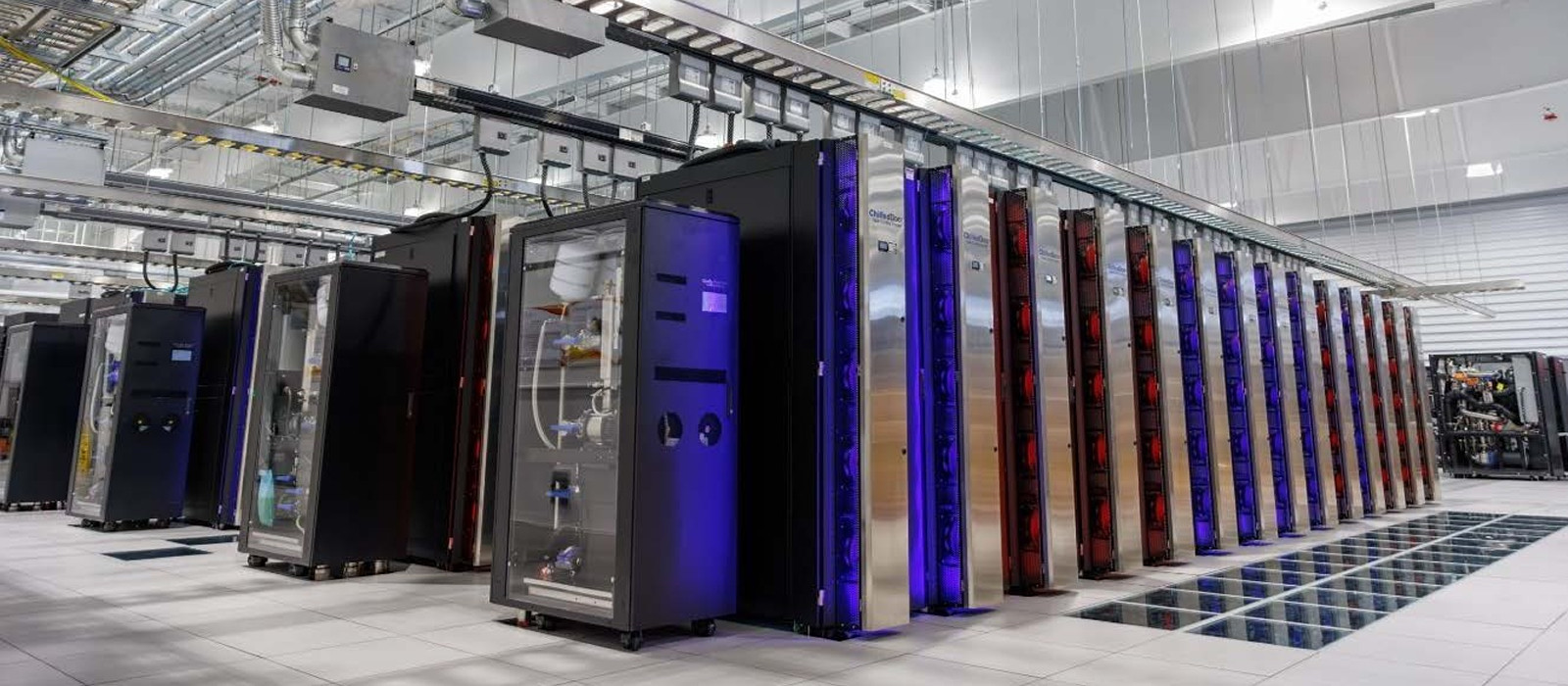
Developments driven by artificial intelligence and high-performance computing continue to increase infrastructure demands. Whereas a conventional air-cooled rack usually operates at 5-10 kW, today’s AI racks commonly exceed 100 kW. NVIDIA's GB200 NVL72 has a reference power density of approximately 120 kW, while the GB300 NVL72 can reach up to 142 kW. At these densities, direct-to-chip liquid cooling is no longer an option but a platform requirement.
Redundancy Is More Than Backup Equipment
One of the most critical requirements for a data centre is high availability. However, a system does not become resilient simply because major equipment has a backup.
An N+1 configuration provides one additional unit beyond operational requirements, while a 2N architecture consists of two fully independent infrastructures. Redundancy must be ensured not only at the equipment level but across the entire system.
Backup capacity alone is insufficient. Even if two power sources are available, a single incident can disable both if their cables follow a shared route.
For this reason, A and B power feeds, cooling circuits, and telecommunications entry points must be physically separated. The objective is to eliminate single points of failure wherever possible.
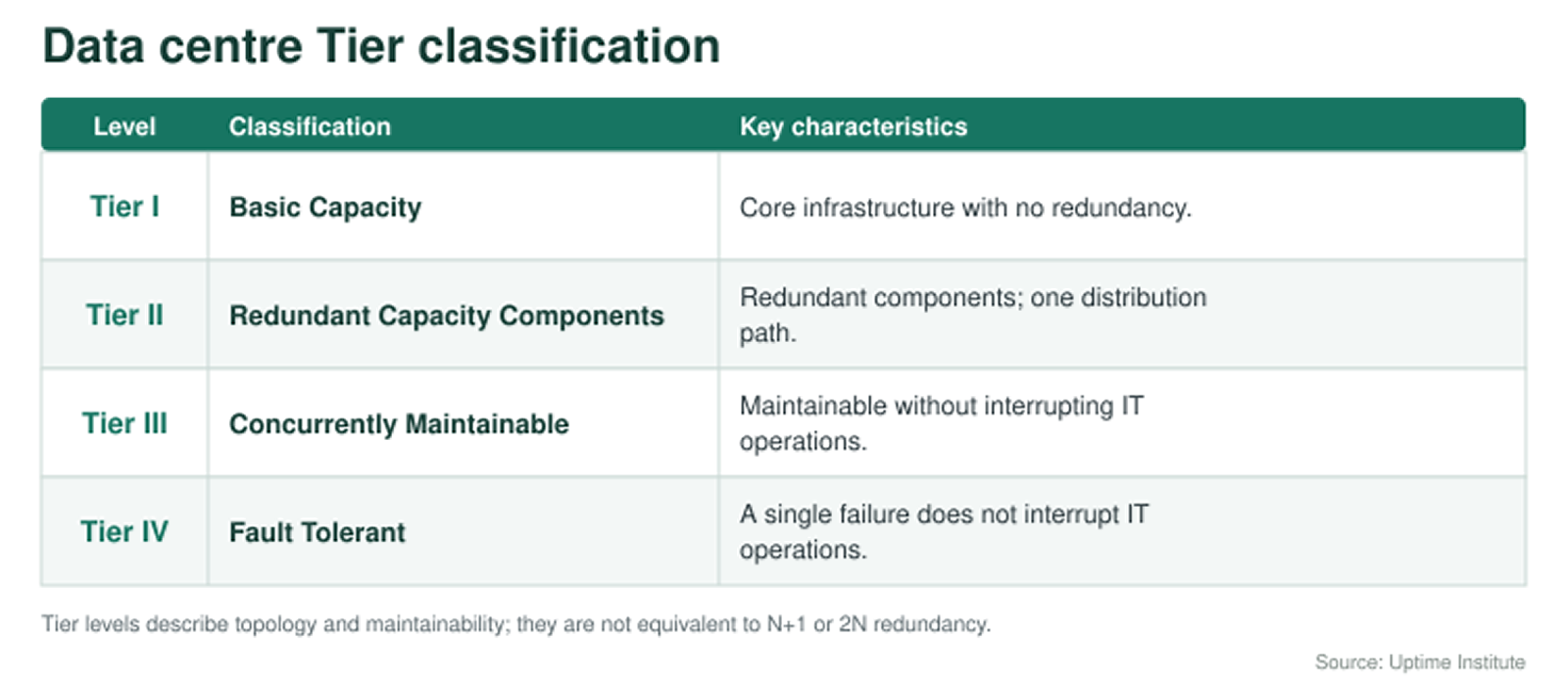
One of the most widely recognised frameworks for determining the required level of redundancy and maintainability is the Uptime Institute Tier classification system. Tier III is based on the principle of concurrent maintainability, meaning that any component or distribution path required for operation can be taken out of service for planned maintenance without interrupting IT operations.
Tier III does not provide complete fault tolerance against every possible failure scenario. Instead, it ensures that planned maintenance activities can be carried out without downtime. Alongside the Tier framework, the EN 50600 series of standards (and its international counterpart ISO/IEC 22237) is also widely used in Europe. Unlike Tier classifications, EN 50600 defines availability classes separately for different infrastructure systems. On the telecommunications and cabling side, ANSI/TIA-942 remains a common reference. Ultimately, the governing standard is determined by the client's requirements.
Power Supply and Cooling: Interdependent Systems
The electrical infrastructure of a data centre must be designed as though the utility grid could fail at any moment. Uninterruptible power supplies (UPS) continuously feed IT equipment without interruption and use batteries to bridge the few seconds required for generators to start and assume the load. IT equipment receives dual A/B power feeds, while critical and non-critical loads are distributed through separate systems.
Cooling is the second cornerstone of reliable operation. Heat generated by servers must be removed continuously and reliably, while the energy consumption of the cooling system has a significant impact on facility efficiency. As a result, chillers, pumps, and piping networks also require redundant configurations.
Cooling water demand depends heavily on the selected technology and local climate conditions. An important distinction is that the cooling fluid circulating in a closed-loop system is not the same as the facility's actual water consumption, which is primarily driven by evaporative heat rejection and operational losses. Water-use efficiency is measured through WUE (Water Usage Effectiveness), which compares annual on-site water consumption with the energy consumption of IT equipment.
Water demand can be reduced through effective cold-aisle and hot-aisle separation, elevated temperature setpoints within safe operating limits, free cooling strategies, and the application of dry or hybrid cooling technologies. Properly designed liquid-cooling systems can also improve both energy and water efficiency. However, water conservation and energy efficiency may sometimes conflict, making it essential to evaluate the entire system, local climate conditions, water availability, and reliability requirements together.
Modern facilities increasingly utilise free cooling, local environmental conditions, and waste heat recovery. Recovered heat can support nearby buildings or district heating networks, but these opportunities must be considered from the earliest stages of project development.
Fire Protection: Early Detection, Delayed Water Release
Fire protection in data centres has two defining characteristics. The first is early detection. Server rooms commonly utilise aspirating smoke detection (ASD) systems, which continuously sample air and can detect overheating electronic components long before open flames occur.
The second is controlled water release. Critical areas are typically protected by pre-action sprinkler systems whose pipework remains filled with compressed air or nitrogen under normal conditions. Water enters the system only when two independent fire detection events occur and the sprinkler head itself activates.
As a result, a mechanical failure or false alarm alone cannot flood critical equipment. Particularly sensitive areas are often protected using clean-agent fire suppression systems that leave no residue.
Because of this complexity, fire strategy, detection systems, and suppression systems cannot be designed independently. Detection logic, sensor placement, and suppression control must be developed as a coordinated solution. In international practice, these disciplines are often grouped under a single "Fire" category, whereas in Hungary they are typically divided among multiple engineering specialisations.
Water Protection in Critical Areas
A unique challenge in data centres is that, although water may be essential for cooling and fire protection, even a minor leak can pose a serious risk to IT equipment.
Rainwater drainage systems should therefore be separated from critical spaces, and wherever possible, water pipes, drains, and roof penetrations should be avoided above server rooms. This does not conflict with pre-action fire suppression systems, as their pipework remains dry under normal operating conditions and only fills with water during a genuine fire event.
For systems carrying water, glycol, fuel, or other liquids, drip trays, leak-detection cables, and point sensors support rapid intervention. The objective is not only to contain leaks but also to identify their source quickly and manage incidents safely.
Reliability Depends on Coordination
Data centres concentrate an exceptionally high density of technical systems. Mechanical and electrical routes, fire detection and suppression systems, security systems, and IT cabling all occupy the same physical space.
A clash identified too late can lead not only to costly redesigns but also to compromised redundancy or maintainability.
For this reason, BIM-based multidisciplinary coordination, clash detection, and standardised equipment coding are particularly important in data centre projects.
CFD, or Computational Fluid Dynamics, enables engineers to simulate airflow and heat distribution virtually within a building and its surroundings. These simulations can identify potential hotspots in server rooms, hot-air recirculation, and adverse interactions between outdoor cooling equipment and generator systems before construction begins.
Fire simulations evaluate evacuation scenarios, smoke and heat control performance, and suppression system effectiveness. Designs must also be prepared for future testing. Before commissioning, the interaction of backup power systems, cooling infrastructure, controls, and security systems should be verified under simulated load conditions and failure scenarios.
Continuous Operation Starts at the Design Table
CÉH's integrated design approach and in-house multidisciplinary collaboration enable us to address the complex infrastructure requirements of data centres as a single, coordinated system from the earliest conceptual stages.
Because the reliability of the digital world begins long before the first server is switched on. It starts at the design table.