The Story of Tatabánya’s Multi-Functional Sports Arena
The latest issue of Építész Közlöny turns its attention to spaces for physical activity, focusing on gyms and sports arenas and presenting built examples to share designers’ perspectives and the key takeaways of the topic. This thematic issue also features the Tatabánya Multi-Functional Sports Arena designed by our team, which has been operating since 2022 as a key venue for Tatabánya’s sports and cultural events. For the city, it marked a genuine step change: modern infrastructure capable of hosting major events, a stronger community gathering place, and noticeably greater regional visibility.
The article is available here in the online edition of Építész Közlöny
Below, we are publishing the full article as it appeared in Építész Közlöny.
Tatabánya Multi-Functional Sports Arena
Purpose and concept of the real-estate development
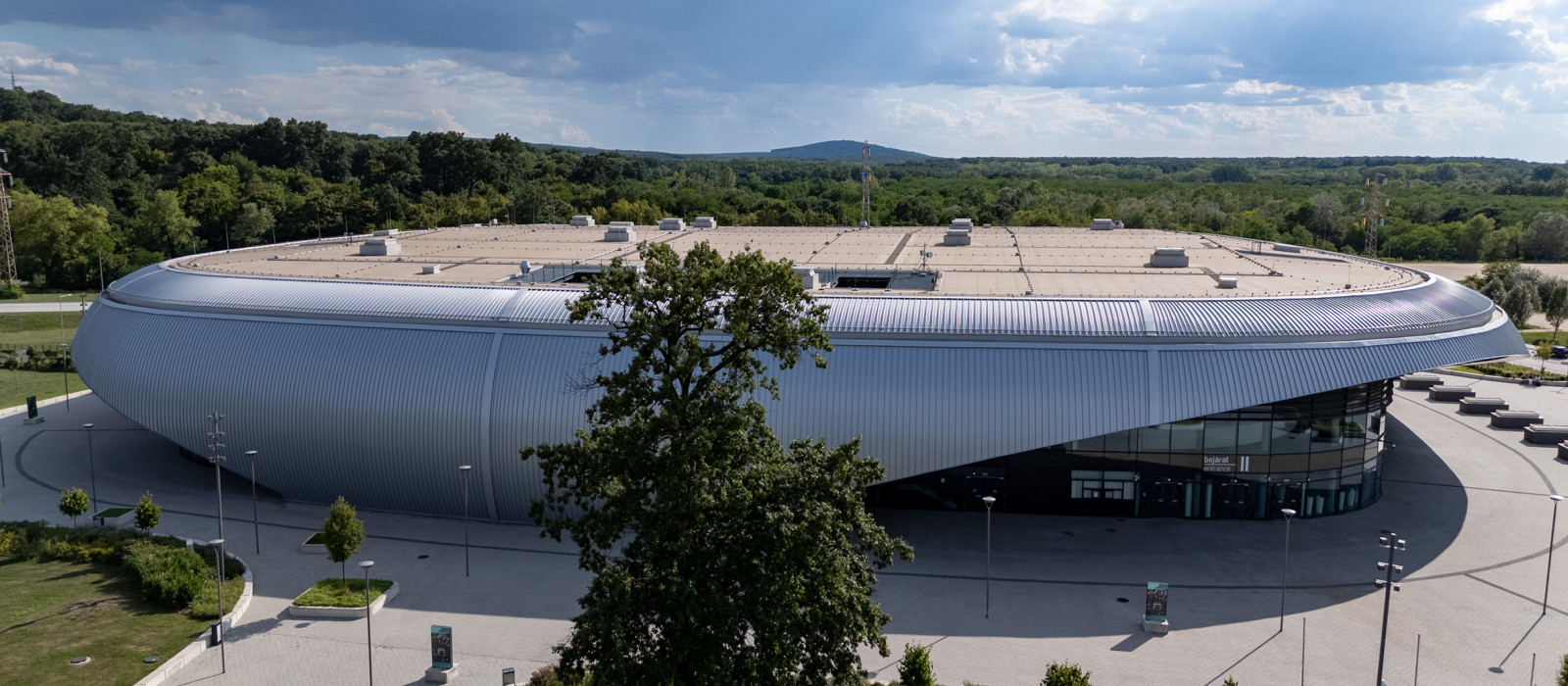
A larger sports complex can reshape the character of its surroundings and have a significant impact on the townscape. Looking at the history of Tatabánya, the primary impression is of the city’s industrial nature. From the end of the 19th century and the beginning of the 20th century, the mining character also defined the city’s atmosphere. As a consequence, the time seemed to have come for a large-scale building to be introduced into the urban fabric—one that would open new perspectives not only for Tatabánya but also for the wider area, while supporting a harmonious connection to the city’s historical characteristics. Launched in 2016, the project aimed to create a complex that not only provides a venue for a single sport, but offers international-level technological sophistication for a wide range of disciplines (handball, tennis, fencing, wrestling, athletics, judo), and also has sufficient flexibility to accommodate other types of events (concerts, city events).
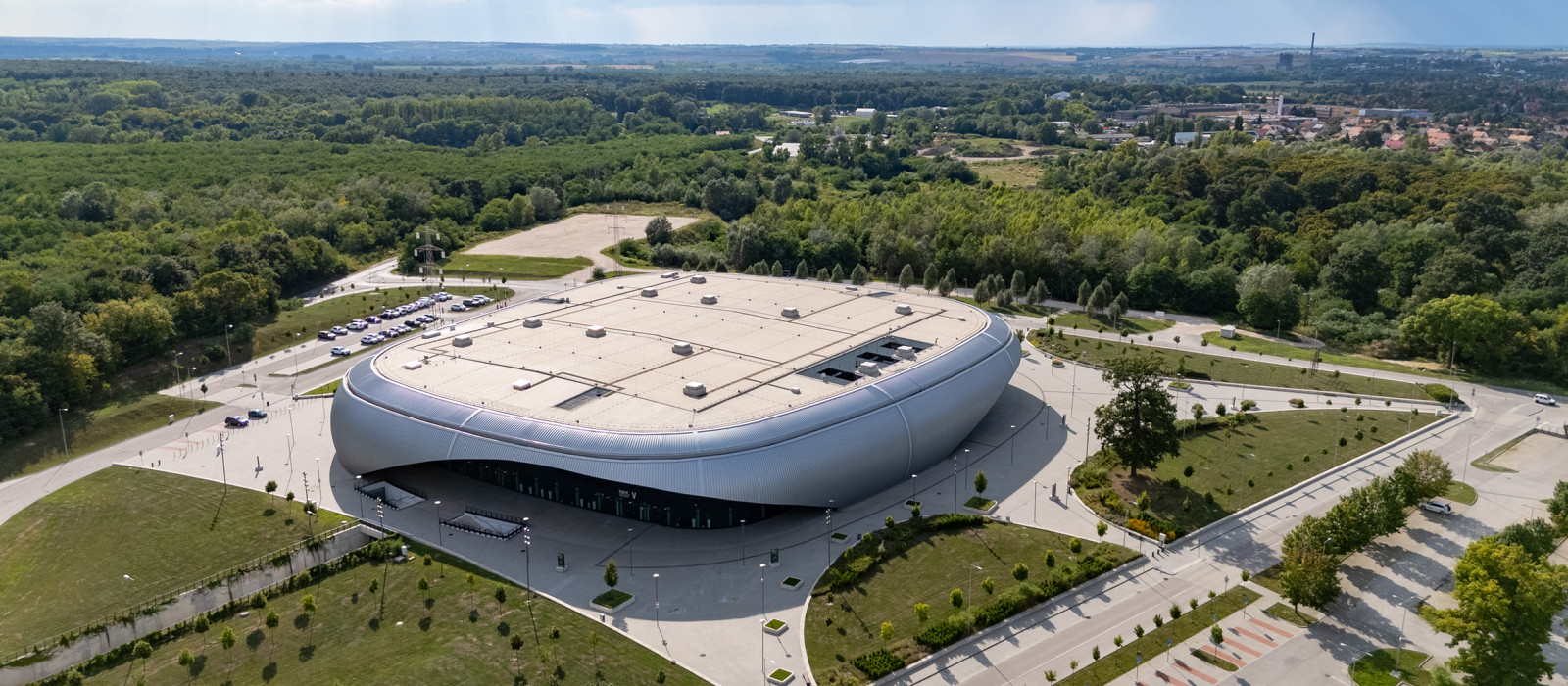
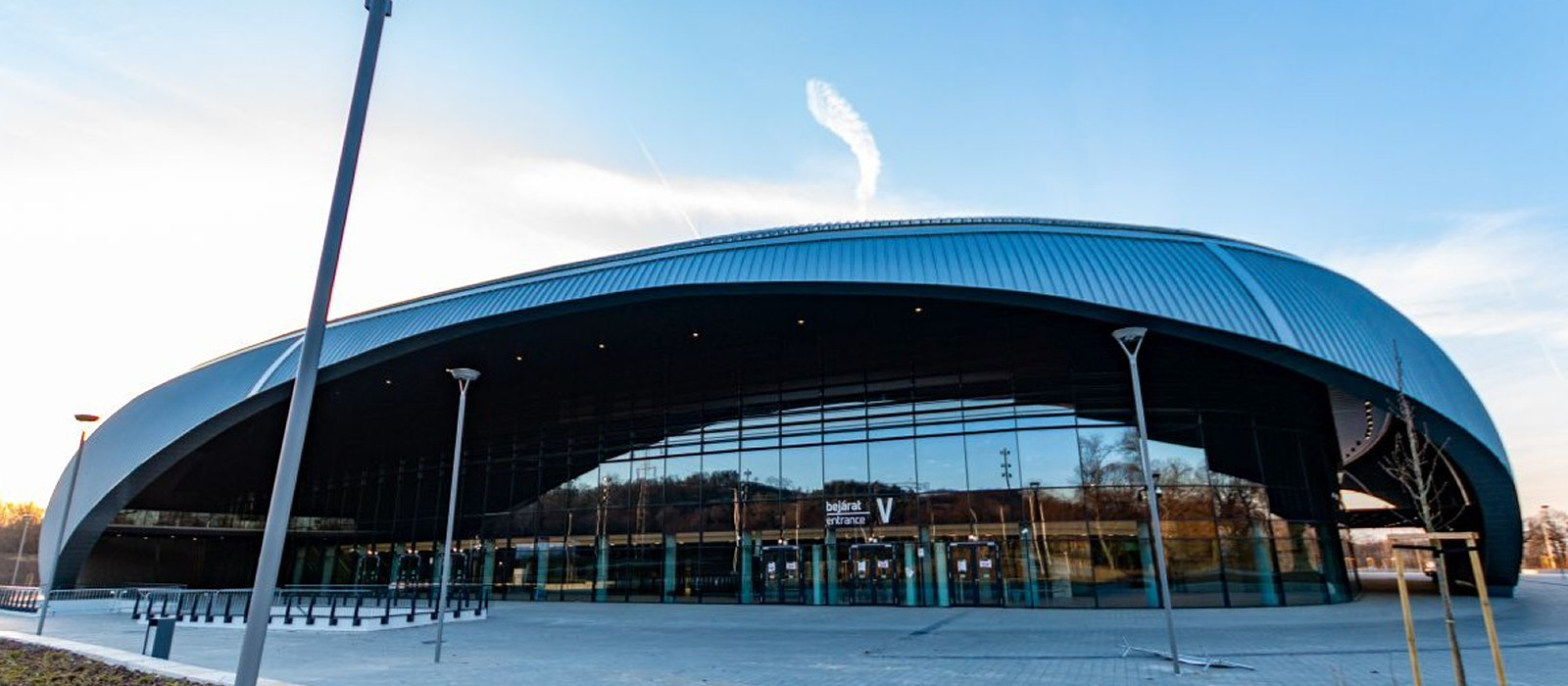
The concept of the development is strongly expressed in the building’s appearance, especially in the façade design. An important consideration was that sports events increasingly strive—particularly those broadcast by the media—for a representative, experience-enhancing visual impact that can even heighten the spectators’ mood. The impressive outer “shell,” shaped like a pebble, is the result of parametric design: the full 3D structure of the building had to be developed precisely, and the elements of varying sizes then manufactured with millimetre accuracy. The sheet structure wrapping around the building rises at the entrance, enabling the visibility of the continuous glazed surface behind it. A distinctive feature of the hall is that, when viewed from above, it also presents a façade-like image, visible from a bird’s-eye perspective. This “fifth façade” makes it possible to create drone footage and striking images, which can be ideal when broadcasting sports events. During the design process it was particularly interesting that such aspects also had to be taken into account—highlighting the close relationship between sport, architecture, and media.
Architectural and urban development concept
Because of its multi-functional nature, the project involved a complex design and construction process. Beyond the technological and regulatory parameters, an exceptionally wide range of functional aspects also had to be considered. From the arrival of athletes and spectators—which must be strictly separated from an architectural perspective—many routes had to be designed (VIP guests, athletes, home and away supporters, media), all the way to cloakroom use, food and beverage purchases, buying supporter items in the shop, and ensuring adequate sanitary facilities. Another key focus during the design was the mobility of both the sports venues and the seating areas. Movable stands and adaptable playing areas enable the hosting of international-level events, and in turn have triggered a process of urban and regional revitalisation.
Brief description of the development
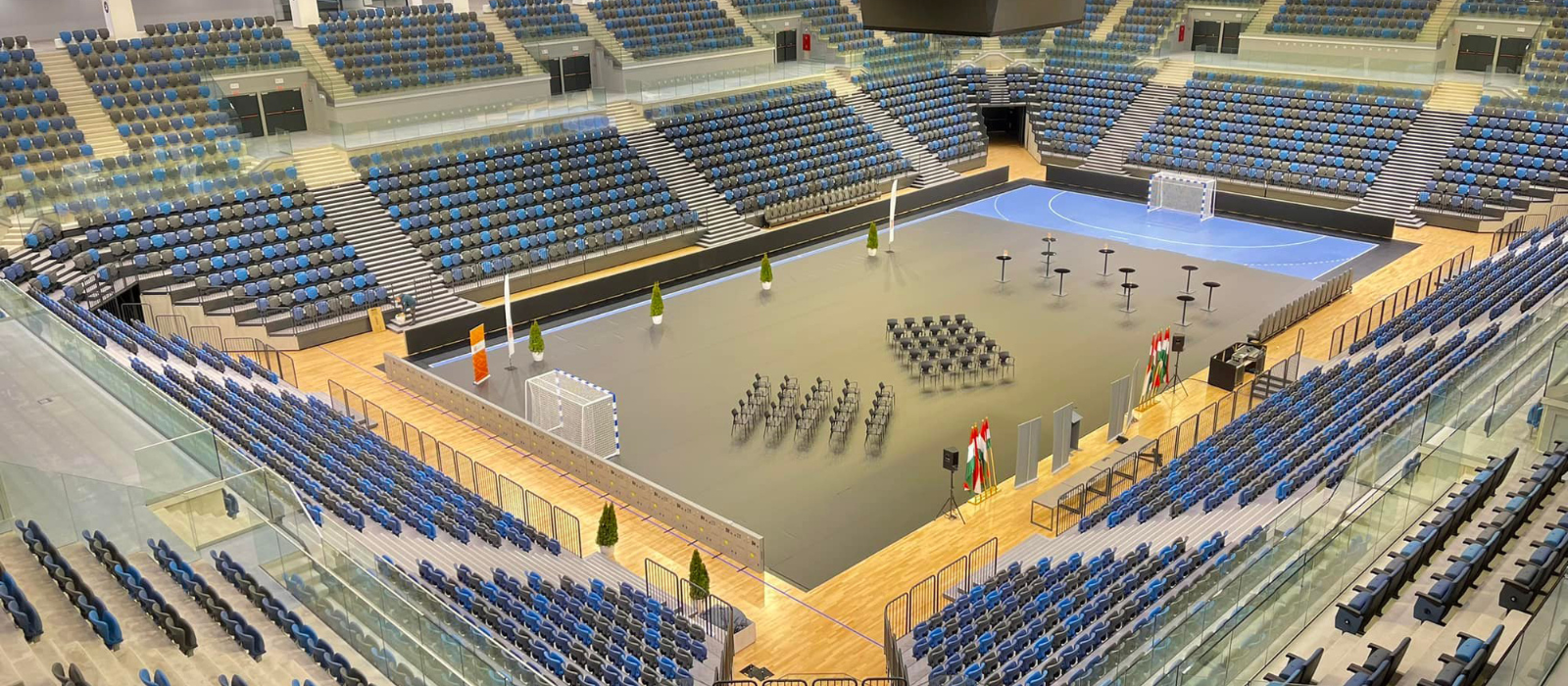
Delivered under a Design & Build system, the building is a multi-functional, indoor sports arena capable of accommodating 6,000 spectators. It is suitable for hosting international handball competitions and world events, as well as for their television broadcast. The arena is complemented by a fencing hall that can also serve as a training space, accommodating 20 pistes. The new facility primarily serves the training and matches of the internationally renowned, first-division handball team of Tatabánya; it also became home to the wrestling and judo sections, while the fencing section can use a dedicated fencing hall within the building.
The floor level of the competition area is the same as that of the fencing hall, and its independent use can be ensured even simultaneously with handball matches. The competition area was positioned—together with the necessary athlete support and changing functions—so that these were placed on a basement level (–6 metres) reserved primarily for athletes.
On the southern side of the building, beneath the operator and VIP entrances, an intermediate mezzanine level (–3 metres) was created. From a side corridor, the building’s operational offices and the coaches’ and section offices open off this level.
On the ground floor above the mezzanine (0 metres), the public circulation areas were located. The double-height entrance hall on both sides, as well as the museum, ticket offices, cloakrooms, buffets, sanitary blocks and smaller ancillary functions, were arranged as a public level accessible via entrances with different functions on multiple sides.
Internally, the ground-floor foyers (and also externally around the building) are fully walkable in a continuous loop. From this internal ring-corridor system—also created on the upper level—the stands in the various sectors are filled from top to bottom.
The handball courts were designed in compliance with EHF requirements. With the mobile stands retracted, the competition area is also sized to accommodate two crosswise practice handball courts. On the ground floor, in addition to the main entrance for home supporters, several other entrances were provided for different functions, such as the away supporters’ entrance, the athletes’ entrance (also serving operation and access to the sections), the VIP entrance, and a dedicated media entrance—positioned in accordance with the building’s internal functional layout.
Use of the competition area is multi-purpose. Beyond sports events, the multi-functional hall space must also be expected to host light and classical music concerts, as well as spoken-word and dance theatre performances. By partially opening the hall space to the fencing hall, the facility becomes suitable for exhibitions, fairs, professional expos, large receptions, events, balls, and similar occasions.
Within the sport function, in addition to classic matches played in front of an audience (where a 28×50 metre clear area in line with EHF was ensured), during training sessions the mobile stands designed along the two long sides of the court can be kept in their pushed-in position. In the resulting increased clear space of 64.40 metres in length, the playing field can be divided into two by a mobile space divider, allowing two handball teams/age groups to train simultaneously on the crosswise practice courts. When the hall is used for combat sports (wrestling, judo) during international competitions or regional training camps, the expected smaller audience allows the mobile seating to be pushed in, increasing the amount of tatami and wrestling mats that can be placed at once. In such cases, the fencing hall area is used for warm-up. In determining the plan size of the hall space, the handball court space requirements set out in the “EHF Arena Construction Manual” were taken as the main basis, including the standard-size run-off zones. The clear height of the hall space was determined on the basis of valid international (and national) sport-specific regulations containing the competition requirements of the sports defined in the programme. For multi-purpose use, the required clear height—free size without structural intrusions—is min. 12.5 metres.
The 1st-floor level above the ground floor (+4.5 metres) on the southern side is primarily reserved for VIP guests. They arrive via a separate entrance and stair/lift system, secluded from the general public, from the side opposite the main entrance. The catering and event rooms on this level can also be rented for other private events (conferences, lectures, celebrations, etc.).
The southern side of the 2nd-floor level (+9 metres) is reserved for media representatives. Here, radio, TV, and journalists can watch the matches on the competition floor; the press centre is also located here. As a separate unit, this level can likewise be rented for other events, conferences, etc.
The pedestrian circulation zones surrounding the building—green “islands” with planting above—reflect the façade motifs in their form on the one hand, and on the other indicate the direction toward the building entrances and back toward the passages leading to the car parks.
Innovative technical and environmentally conscious solutions
The structural design of the building’s double-curved, irregular “pebble”-shaped, steel-structure roof covering posed a serious challenge and a true test.
Given the project’s scale and complexity, it was clear from the outset that the geometry could only be handled through a parametric approach, because any general change in the geometry—inevitably occurring as the project progressed—would have become almost unmanageable without the algorithm that generated the model. Beyond flexible handling of geometry, the parametric model also made it possible to quickly modify the structural concept. As the project advanced, many solution variants could be tried; certain approaches could be tested and, if necessary, discarded without significant additional effort.
During the project, the Rhinoceros CAD program and its Grasshopper graphical programming environment were used to build the parametric model. The Tekla Structures model generated directly from the parametric model was further detailed as the project progressed.
Cooperation with other disciplines was carried out via IFC-based data exchange.
Expressed in numbers, the result is impressive:
- 780 tonnes of steel structure,
- 96 unique, segmented main girder fabrications,
- 3,337 unique curved purlins,
- 7,680 m2 façade area,
- 2,453 unique, fitted, cut, marked cladding-receiving U-profiles on the segmented fabrications,
- 71,287 Tekla elements,
- 471 notches, markings and cuts on the most complex segmented main girder fabrication.
Financing, sales and leasing
The investment was implemented with support from the Hungarian state; no EU funds were used during the development.
The site is currently owned by the municipality, while the building is owned by the Hungarian state.
The Hungarian state designated National Sports Agency of Hungary as the operator of the building.
Through its multi-functional design, the facility will enrich Tatabánya and the region with sports events and cultural programmes. It is worth highlighting that the arena was selected as a main venue for the 2027 Women’s Handball World Championship. Major international sports events not only have positive effects on the host city, region or country’s economic performance in themselves, but can also significantly contribute to the host region’s long-term competitiveness.
Key data
- Project name: Tatabánya Multi-Functional Sports Arena
- Plot area: 88,426 m2
- Built-up area: 12,236.99 m2
- Green area: 40,472.94 m2
- Gross floor area to be included in the floor area ratio indicator: 21,486 m2
- Construction cost: 19,030 million HUF
- Responsible architect (approval design): Annus Marina
- Responsible designer, building permit: Páll Ákos
- Responsible designer, construction documentation: Balogh Ferenc
- Developer: Beruházási, Műszaki Fejlesztési, Sportüzemeltetési és Közbeszerzési Zrt.
- General designer: CÉH Tervező, Beruházó és Fejlesztő zRt.
- Contractors: Fejér-B.Á.L. Zrt. and ÉPKAR Zrt.
- Operator: Nemzeti Sportügynökség Nonprofit Zrt.
- Photo credit: Kégl Marcell – CÉH zRt.; ÉPKAR Zrt.
The source of the article: Építész Közlöny