Construction industry crisis or restructuring?
Thoughts from the latest episode of the Weinberg Podcast
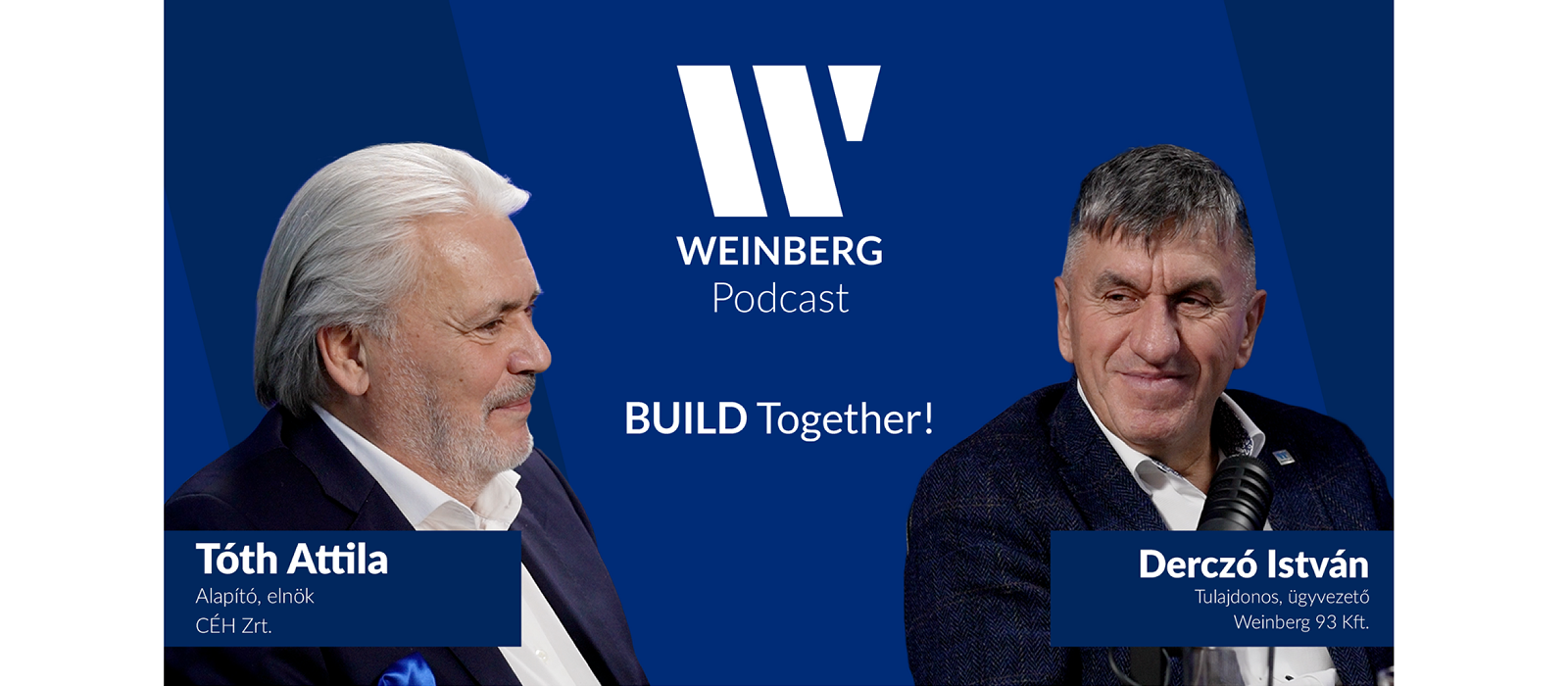
In the latest episode of the Weinberg Podcast, Attila Tóth, Founding Chairman of CÉH zRt., spoke with István Derczó, Owner and Managing Director of Weinberg, about the current state of the construction industry, the real processes behind the frequently mentioned “crisis”, and the corporate and industry-level actions that may provide real points of reference in the coming years.
The construction industry as a litmus test
During the discussion, Attila Tóth described the construction industry as a litmus test, as it simultaneously reacts to economic, social and environmental processes. For this reason, it is misleading to speak of a single, uniform construction industry crisis. Different segments respond differently to changes in the financing environment, the slowdown of investment decisions, or the evolution of industrial demand. The more relevant question is therefore: where and what types of crisis signals can be observed, and what responses can be given at company level.
Conscious responses in an uncertain environment
One of the key messages of the conversation was that in an uncertain market environment, responses cannot be instinctive. Conscious portfolio thinking, along with the continuous reassessment of markets and project types, becomes a critical factor. The goal is not to open in every direction at once, but to develop real alternatives that reduce exposure. Attila Tóth emphasized that development cannot stop even in times of crisis. Learning, adopting new methodologies and technological development are not optional choices, but prerequisites for competitiveness.
Efficiency, digitalisation, competitiveness
The podcast also addressed the fact that digitalisation does not merely mean introducing new tools. The real question is how capable a company is of making decisions based on data, and how effectively it can connect the processes of design, construction and operation. An ambitious yet very concrete target vision was also outlined during the discussion: lower cost levels, reduced reliance on manual labour, and shorter lead times – without these, it is impossible to remain competitive in the international arena in the long term.
Workforce and training: a shared responsibility
Workforce availability and talent pipeline development were highlighted as key topics. The participants agreed that training is not only a corporate interest but also a societal responsibility. Young professionals must be helped to understand the interconnections within the construction industry and be provided with knowledge that can be quickly applied in practice. Dual education, practical programmes and internal knowledge sharing are all tools that help reduce the risks associated with long onboarding periods and provide a more stable career path for the sector.
Shared thinking about the future
The Weinberg Podcast episode was not merely a situational assessment, but an exercise in shared thinking about how to respond in a prepared and conscious way to a constantly changing environment. Green retrofit, infrastructure developments and projects with higher added value are all directions that can ensure more stable long-term operation.
The full conversation is aimed at those who are not only seeking to survive the coming years in the construction industry, but who want to build competitive advantage through conscious decision-making.