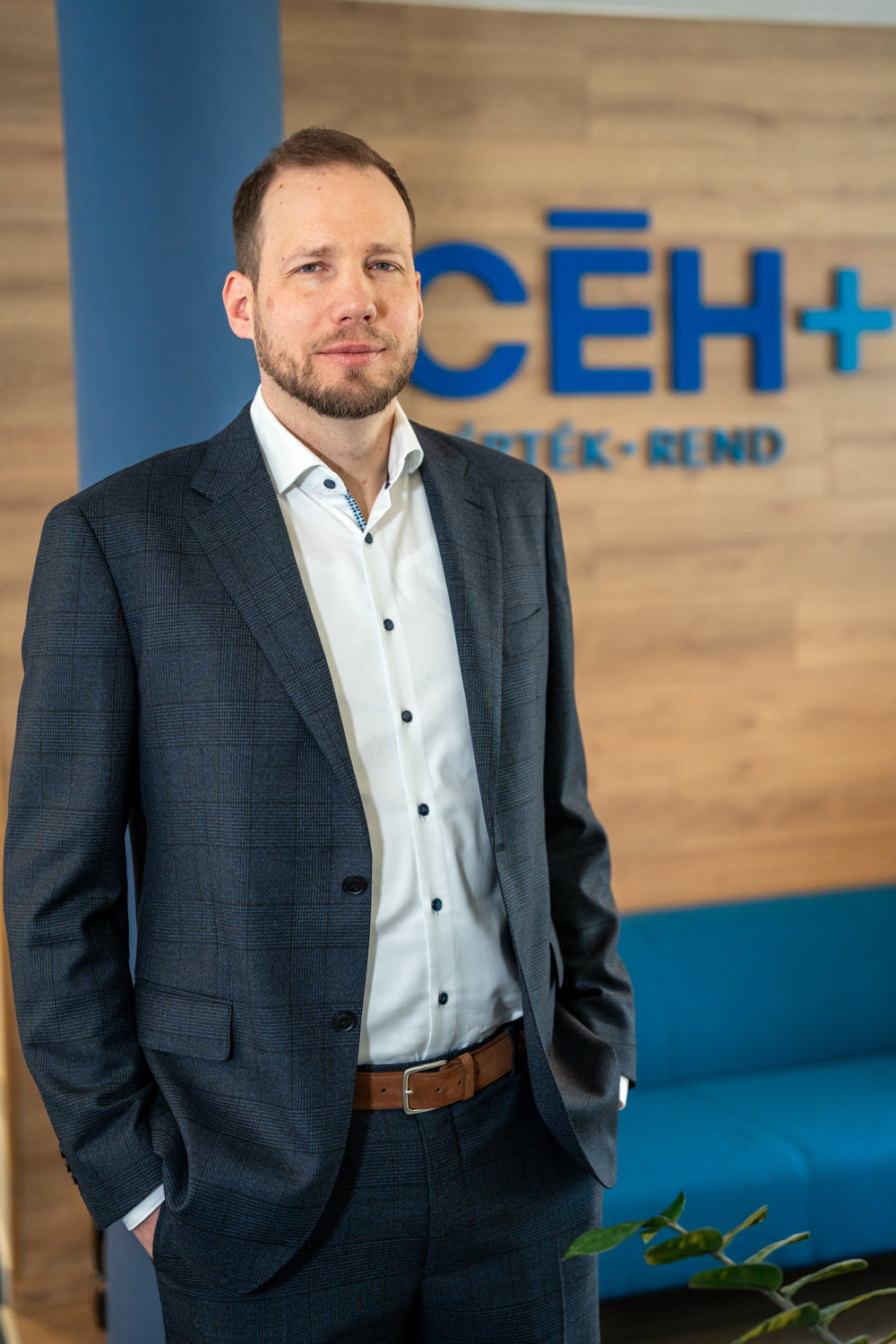
HVG interview with Attila Borbély, the newly appointed CEO of CÉH zRt.
In our recent article published on HVG, Attila Borbély, the newly appointed CEO of CÉH zRt., shares his thoughts on the leadership change, the challenges facing the market, and the role of AI.
You were appointed from within the company and have been working here for more than 20 years, so you have climbed the classic career ladder. Could you tell us a few sentences about this?
In a way, the classic saying applies to me: I was in the right place at the right time. I started as a structural engineering intern, worked as a designer for a little over 10 years, then completed an MBA course in 2017 and, in parallel, transitioned into management. Over the more than 20 years since 2005, CÉH has undergone significant growth in every respect, continuously providing development opportunities for all employees to this day. The challenging period between 2008 and 2014 was no exception in this regard; it was simply necessary to understand and see how, in different external circumstances, one can be most useful. Our service and reference portfolio was already very broad back then, and I had the opportunity to work on a variety of design tasks, from standard buildings through large industrial facilities to monument restoration projects. We typically worked for international clients, so I was able to experience different national and corporate cultures—from Western countries all the way to the Far East—so many, in fact, that it is hard to count.
You replaced your predecessor, Tibor Losonczi, after 26 years. What would you like to preserve, and what would you like to do differently?
At CÉH, we follow our own corporate philosophy. We know what we mean by our Values, and what “More than engineering” means to us. Two hundred engineers are organized across numerous professional fields and service units; Tibi has always been a model example of how to keep this system in balance and how to be a supportive, understanding leader in any situation.
Just as globally, our profession and market are also undergoing a generational shift—one that those will be able to get through who can renew themselves, professionally and organizationally. This may sound simple, yet across our entire professional and operational activity we must find the path forward, even though we do not yet have ready-made patterns for it. A technological revolution is happening at the same time—in which AI rewrites everything—and, in parallel, the world order is changing. We need to apply new strategies, with the necessary flexibility and ability to adapt.
What helps you transition into your new role?
I have always been extremely fortunate with my colleagues; in every situation I could count on their trust and support. In essence, I grew up here. It is a major advantage that I personally know the vast majority of people working at CÉH; I have worked with all our disciplines on projects, supported each other in tenders, and of course gained countless shared experiences through our community programs. In essence, the cohesive strength of CÉH’s culture makes effective change possible for any of our employees.
What is it that allows such a renowned company to differentiate itself in the market today?
With a bit of wordplay: AI is it. Since the beginning, CÉH has been built on complex engineering services. In Hungary this is unique, and even internationally it is rare to find such an integrated combination of disciplines and experience as the engineering team at CÉH can provide. Today this is complemented by Artificial Intelligence, which enables us to offer solutions to our clients in a data-driven way, in less time and in more variants.
The macro environment in which you took over is not easy. To what extent will the expected decline in investments reshape the way the market functions, and how much will it force engineering and design offices to adopt new ways of thinking?
A dual effect must be considered. On the one hand, there is the global and domestic environment, whose impacts are likely to put construction output on a declining trajectory in the coming years—how long, remains to be seen. I would note that there was an investment wave that had to consolidate; now additional external and internal effects have been added that could push the construction sector below a healthy level. The declining volume of project preparations—such as building-design planning tasks—already indicates this.
On the other hand, the technological revolution unfolding before our eyes, the effects of global warming, and a few other trends that could be considered “standard” are completely transforming market needs. Put simply, the projects and services we have become accustomed to over the past two decades are being replaced by new ones. These must be delivered differently, using radically new engineering methods and tools, in less time and with fewer resources. That is the real challenge—and it is a very exciting question where this will lead.
As a leader, how can you manage short-term market uncertainty while also building for the long term professionally?
Changes in the world have accelerated so much that short-term uncertainty has essentially become permanent. Unpredictable, sudden growth can cause at least as many problems as a narrowing market. For this reason, we always need to prepare multiple scenarios so that we can respond quickly in any situation. What we used to consider “long term” has shortened in time—it happens sooner—so it is crucial that we recognize changes in time and adjust our strategy accordingly. This is exactly the kind of impact produced by the digital technological and climate changes mentioned above.
If we break the picture down by sectors: where is there real movement today?
Every facility has a natural renewal cycle; that does not change. I do not think the market segments themselves change as such. Of course, there are always waves—what there is more demand or funding for at a given time, or where geographically demand exists. What changes materially is the nature of the construction “product” itself; for example, instead of greenfield investments, we can expect a much higher share of renewing and converting existing facilities. There are also areas gaining momentum, such as energy, driven by rising energy demand and climate change.
For many investors today, the cost side is at least as much of a factor of uncertainty as financing. Where are the biggest risks right now?
Because everything has accelerated globally, changes occur more frequently and on a larger scale, which means that the business plans and lead times we are used to no longer work. In other words, by the time an investment would be completed in the conventional way, it will likely be needed in a different form—or for something entirely different. On the one hand, we need to shorten the lead time of investments and make costs more predictable; on the other hand, we need to make our buildings easier to adapt. We will not always be able to build new—if only for sustainability reasons.
How has the share of domestic versus foreign investments changed in recent years?
International expansion naturally broadens the market for a business to a very large extent; however, in this profession it is far from simple. The Babylonian confusion exists not only in languages, but also in regulations and professional practice habits. At the same time, the direction is clear for CÉH: we will take on work abroad as well.
In conclusion, what would you recommend to engineers?
"I often put it this way: you have to be a chameleon. Recognize situations quickly, adapt with the necessary patience, and then solve them properly.”
This article is an adaptation of the interview published on HVG on 23 February 2026.